Structural Health Monitoring Console
Literature Section
How can hidden damage in a structure be detected before it becomes visible?
The aging of infrastructure and the increasing need for reliable maintenance have made Structural
Health Monitoring (SHM) an essential tool for ensuring the safety and serviceability of engineering
structures (Farrar et al., 2025; Kamariotis et al., 2022; Limongelli, 2020). Early damage detection
enables timely maintenance, reduces repair costs, and helps prevent catastrophic failures. Although SHM
often relies on global vibration-based methods, these techniques are often less sensitive to small,
localized damage during its early stages. To address this limitation, local sensing approaches such as the
Electro-Mechanical Impedance (EMI) technique are employed. By monitoring changes in the
electrical admittance of piezoelectric (PZT) sensors bonded to a structure, the EMI technique provides
high sensitivity to localized stiffness variations, enabling the detection and localization of incipient
defects before they significantly affect the global structural response. (Bhalla & Soh, 2004; Peairs et al.,
2004; Park et al., 2000).
In this experiment, students investigate the EMI technique by monitoring a beam with multiple bolted
joints that are instrumented with PZT sensors. Electrical admittance signatures, in terms of conductance
(G) and susceptance (B), are recorded for both undamaged and damaged conditions, where damage is
simulated by loosening a bolted joint. Students compare the measured signatures and evaluate the Root
Mean Square Deviation (RMSD) damage index to identify the presence and location of damage
(Giurgiutiu, 1997). The experiment demonstrates the high sensitivity of the EMI technique for detecting
local stiffness changes and provides practical experience in smart sensing, signal analysis, damage
quantification, and structural condition assessment. Through this hands-on activity, students gain insight
into an SHM methodology that is increasingly applied in the monitoring of civil, mechanical, and
aerospace structures.
To understand the principles of the EMI technique by detecting and localizing damage in a beam through the analysis of electrical admittance signatures, and to compare its effectiveness with global vibration-based methods.
A beam comprising eight bolted joints was used as the test specimen (Fig. 1). PZT patches were bonded
at each joint to serve as sensors. The sensors were connected to an impedance analyzer through a
multiplexer (MUX), enabling sequential acquisition of electrical admittance measurements from all
sensor locations (Fig. 2). Initially, all bolted joints were fully tightened to represent the undamaged (baseline) condition. Electrical
admittance signatures, comprising conductance (G) and susceptance (B), were recorded over a specified
frequency range. Damage was then simulated by loosening one of the bolted joints, and the
measurements were repeated under identical test conditions.
The admittance signatures obtained for the undamaged and damaged states were subsequently compared.
The RMSD damage index was calculated for each sensor to quantify the changes in the electrical
admittance response and to identify the location of the simulated damage.
The conductance signatures obtained under undamaged and damaged conditions were compared for all sensor locations. A distinct variation in the conductance signature was observed at sensors located near the loosened joint, indicating a reduction in local stiffness caused by the simulated damage. The damage severity at each sensor location was quantified using the RMSD damage index. The calculated RMSD values are presented in Table 1.
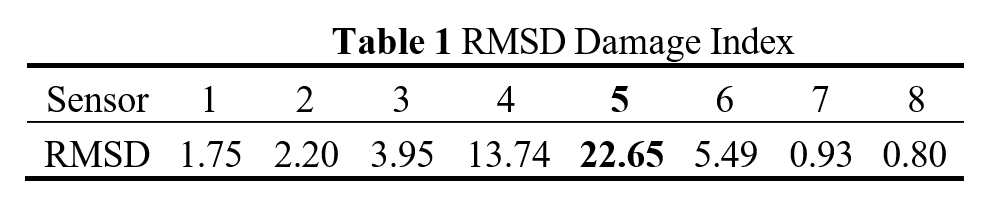
The highest RMSD value of 22.65% was recorded at Sensor 5, correctly identifying the location of the simulated damage. Sensors adjacent to the damaged joint also exhibited elevated RMSD values, whereas sensors farther away showed only minor changes, demonstrating the localized nature of the structural
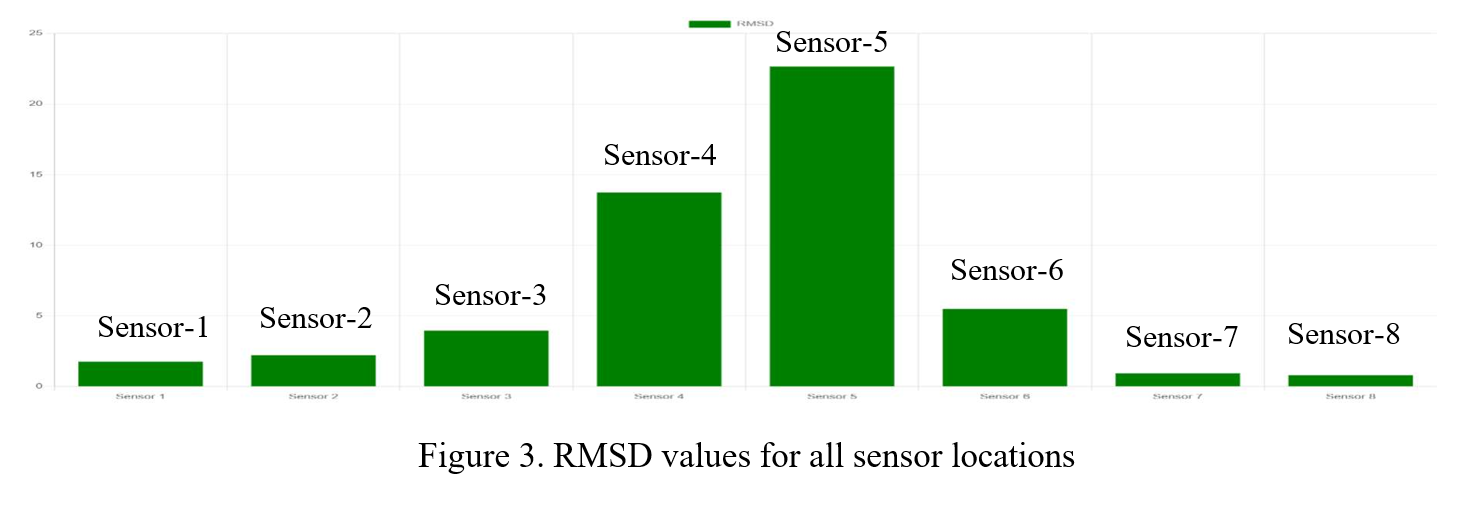
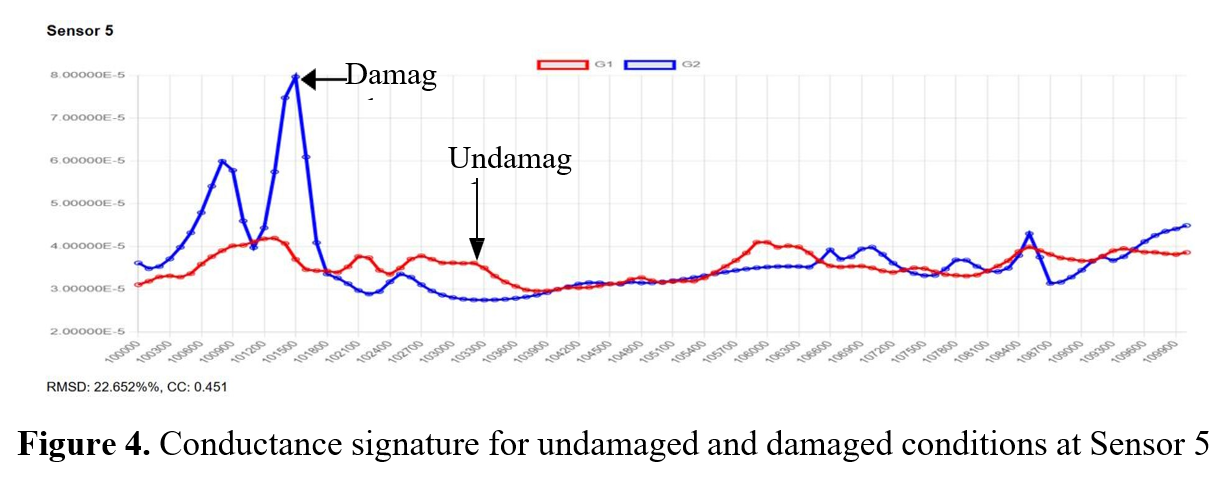
Figure 3 presents the RMSD values for all sensor locations, while Figure 4 compares the conductance signatures of the undamaged and damaged states at Sensor 5, where the most significant change is observed. These results demonstrate the high sensitivity of the EMI technique to localized stiffness changes. Unlike global vibration-based methods, which detect damage through changes in overall dynamic characteristics such as natural frequencies and mode shapes, the EMI technique utilizes high-frequency electrical admittance measurements to identify local changes in structural behaviour. Consequently, it enables reliable detection and localization of small defects, such as loosened bolted joints, before they produce significant changes in the global structural response.
1. Bhalla, S., & Soh, C. K. (2004). Electromechanical impedance modeling for adhesively bonded
piezo-transducers. Journal of Intelligent Material Systems and Structures, 15(12), 955–972.
https://doi.org/10.1177/1045389X04046309
2. Farrar, C. R., Dervilis, N., & Worden, K. (2025). The Past, Present and Future of Structural Health
Monitoring: An Overview of Three Ages. In Strain (Vol. 61, Number 1). John Wiley and Sons Inc.
https://doi.org/10.1111/str.12495
3. Giurgiutiu, V. and R. C. A. (1997). Electromechanical (E/M) Impedance Method for Structural
Health Monitoring and Non-Destructive Evaluation. Proceedings of International Workshop on
Structural Health Monitoring, Edited by F. K. Chang, Stanford University, Stanford, California, 433–444.
4. Kamariotis, A., Chatzi, E., & Straub, D. (2022). A framework for quantifying the value of vibration-based structural health monitoring.
https://doi.org/10.1016/j.ymssp.2022.109708
5. Limongelli, M. P. (2020). SHM for informed management of civil structures and infrastructure.
In Journal of Civil Structural Health Monitoring (Vol. 10, Number 5, pp. 739–741). Springer Science
and Business Media Deutschland GmbH.
https://doi.org/10.1007/s13349-020-00439-8
6. Park, G., Cudney, H. H., & Inman, D. J. (2000). Impedance-based health monitoring of civil
structural components. In Journal of Infrastructure Systems (Number 153).
7. Peairs, D. M., Park, G., & Inman, D. J. (2004). Improving accessibility of the impedance-based
structural health monitoring method. Journal of Intelligent Material Systems and Structures, 15(2), 129–140.
https://doi.org/10.1177/1045389X04039914
8. Baral, S., Negi, P., Adhikari, S and Bhalla, S. (2023), "Temperature Compensation for
Reusable Piezo Configuration for Condition Monitoring of Metallic Structures: EMI
Approach", Sensors, Vol. 23, No. 3 (Feb), Paper no. 1587, DOI: 10.3390/s23031587.
https://doi.org/10.3390/s23031587
9. Bhalla, S., Vittal, A. P. R and Veljkovic, M. (2012), "Piezo-Impedance Transducers for
Residual Fatigue Life Assessment of Bolted Steel Joints", Structural Health Monitoring,
An International Journal, Vol. 11, No. 6 (Nov), pp. 733-750. DOI: 10.1177/1475921712458708.
https://doi.org/10.1177/1475921712458708
10. Soh, C. K., Tseng, K. K. H, Bhalla, S. and Gupta, A. (2000), "Performance of Smart
Piezoceramic Patches in Health Monitoring of a RC Bridge", Smart Materials and Structures,
Vol. 9, No. 4 (August), pp. 533-542. DOI: 10.1088/0964-1726/9/4/317.
https://doi.org/10.1088/0964-1726/9/4/317
Test your EMI Signatures
File with Frequency and G1 & G2